There's a quiet transformation happening inside procurement offices across the country, and it doesn't look like the dramatic, robot-takes-over narrative that tends to dominate the headlines.
It looks more like a Proposal Manager finishing their first draft before lunch instead of midnight. It looks like a Chief Procurement Officer finally having time to think strategically about a vendor relationship instead of chasing compliance checkboxes. It looks, in other words, a lot like human beings doing their best work, just better supported than they've ever been before.
Artificial intelligence has arrived in procurement. And for CPOs and Proposal Managers who have been watching from the sidelines, wondering when the right moment to engage is, the answer is now.

The Productivity Problem Nobody Talks About Loudly Enough
Anyone who has spent serious time in procurement knows the core tension of the role. The work demands precision, strategic thinking, and deep institutional knowledge, but the day-to-day reality is often dominated by volume. Requests for proposals pile up. Compliance matrices need building. Contract language needs reviewing. Vendor histories need pulling. The cognitive load is immense, and the timelines are rarely forgiving.
A recent Gartner survey of 101 Chief Procurement Officers, conducted in early 2026, put a number to something many already suspected: individual AI productivity gains are real, but they aren't yet spreading the way leadership hopes. The study found that GenAI tools are helping individuals move faster, but without intentional redesign of roles and processes around those tools, those gains stay siloed at the personal level rather than lifting entire teams or organizations. As Gartner's Senior Director Analyst Fareen Mehrzai put it, "CPOs must design next-generation human roles focused on guiding AI toward achieving real financial outcomes, rather than mere efficiency gains."
That reframing truly matters. The goal of AI in procurement isn't to replace the professional. It's to redirect them. The analyst who used to spend three hours pulling vendor data can now spend those three hours analyzing it. The proposal manager who used to write boilerplate from scratch can now spend their energy on the differentiating narratives that win the work. This is the promise of AI done right and it's already being realized in sectors and agencies that were willing to move first.

What's Actually Happening Right Now
The federal government, historically not known for moving quickly, has become one of the more instructive case studies in AI-assisted procurement. Federal agencies more than doubled their use of artificial intelligence from 2023 to 2024, according to a 2026 Government Accountability Office report, and they used a range of approaches to build out those capabilities through fiscal year 2025. The General Services Administration has been among the most visible actors, piloting sophisticated AI tools to streamline acquisition planning, technical reviews, and compliance scoring in ways that are setting new benchmarks for speed and rigor.
On the contractor side, the companies and organizations competing for that federal work, the shift has been equally pronounced. Purpose-built AI platforms designed specifically for government proposal workflows have moved from curiosity to competitive necessity in a remarkably short window. One federal contracting firm reported cutting draft turnaround time by 90% and scaling its responses to indefinite delivery/indefinite quantity contracts from two per month to eight, without having to add any new staff members. That's not a marginal improvement. That's a restructuring of what's competitively possible.
In the UK, government AI procurement spending doubled in a single year, with 521 public contracts worth over £1.17 billion awarded in 2025 alone. Across the Atlantic, U.S. federal agencies committed $5.6 billion to AI projects between 2022 and 2024. The scale of these investments’ signals something important: this is no longer a pilot program era. Agencies and organizations at every level are making structural bets on AI as a procurement capability.
Meanwhile, the private sector has been quietly reshaping what a proposal team can look like. Industry data from 2025 found that approximately 65% of proposal teams adopted dedicated RFP software, and 68% were incorporating generative AI into their response workflows, a number that doubled from the previous year. Teams using purpose-built AI agents, rather than general-purpose tools, reported two times higher response accuracy and met procurement deadlines 40% faster. The competitive advantage of early adoption is compressing into the competitive disadvantage of late adoption faster than predicted.
The Human Variable: Where AI Still Falls Short Alone
Here's where the honest conversation must happen, because anyone selling AI as a silver bullet is selling something that doesn't exist.
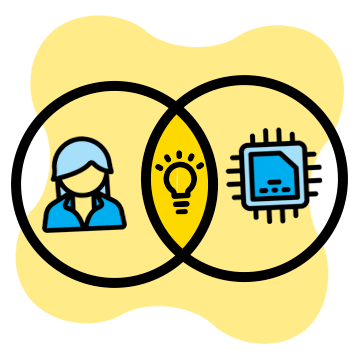
AI is extraordinarily good at certain things in procurement: ingesting and synthesizing large volumes of solicitation documents, surfacing relevant past performance from a content library, flagging compliance gaps, generating first drafts that give writers a strong starting point rather than a blank page. What it does not do is understand the unwritten narrative of a client relationship, the institutional reputation a firm has built over years, the strategic angle that makes one proposal stand apart from five technically compliant competitors.
The best results in AI-assisted procurement come from teams that understand this distinction clearly. When AI generates a first draft, the proposal manager's job becomes more important, not less, because they're now the editor, the strategist, the voice who shapes raw material into something that reads like it came from people who genuinely understand the problem that is being solved. That elevated role requires a different kind of skill than grinding through a compliance matrix for hours. It requires exactly the kind of judgment and craft that great proposal professionals have always brought to the table.
Gartner's research echoes this directly. Their analysts are emphatic that CPOs who want to capture the real value of AI investment need to redesign roles around what humans are uniquely capable of doing: the complex, cognitively demanding tasks that require institutional knowledge, stakeholder navigation, and strategic creativity. Traditional productivity measurements focused on output per unit of time, Gartner notes, are increasingly inadequate for measuring what an AI-enabled procurement team truly produces.

The Governance Question That Can Not Be Skipped
As AI tools become embedded in how proposals are written, how contracts are evaluated, and how vendor relationships are managed, the governance question moves from theoretical to urgent. Who reviews AI's work? What happens when a tool generates content that's accurate but strategically wrong for a specific client? How does an organization maintain its authentic voice and institutional memory when an algorithm is generating first drafts?
These aren't reasons to avoid AI. They're design challenges that separate organizations that extract real value from those who don't. The GovAI Coalition's AI Contract Hub, launched in early 2025, represents one model worth examining: a shared repository of contract templates, cooperative agreements, and best practices built specifically to help public agencies procure and govern AI solutions efficiently. The principle behind it, that shared knowledge and structured governance accelerate better outcomes, applies equally to private sector procurement teams.
The organizations building the right governance structures now are the ones who will be positioned to scale confidently. That means establishing clear human review checkpoints, developing internal expertise to evaluate what AI tools are doing, and measuring not just speed but quality of output and win rates over time. This means treating AI less like software to install and more like a new team member to onboard, train, and hold accountable.

What's Coming: The Next Chapter
Gartner predicts that half of all procurement contract management will be AI-enabled by 2027. The same research projects that AI will reshape 20% of procurement roles by 2030, not eliminate them, but reshape them, with one in five procurement professionals occupying new AI-driven roles that don't yet have names. These are jobs that center on guiding AI systems, interpreting their outputs, managing human relationships that technology will never fully replicate, and continuously improving the tools themselves.
Agentic AI, systems that don't just respond to prompts but actively pursue tasks, make decisions within defined parameters, and coordinate across workflows, is the next frontier already arriving in early deployments. For procurement teams, this means tools that can monitor contract compliance continuously rather than episodically, flag supplier risk in real time, and automatically update content libraries as new proposals are won and lessons are learned. The proposal manager of 2028 may spend less time writing and more time directing, orchestrating a team of human and AI contributors toward a single winning outcome.
The National Association of State Procurement Officials polled all 54 U.S. CPOs and found that AI was a top priority for 2025. The question has moved from "whether" to "how." That shift in the question is where the real work begins.

What CPOs and Proposal Managers Should Be Doing
The gap between organizations confidently embracing AI-enabled procurement and those still watching from the sidelines is widening. The good news is that meaningful progress doesn't require a complete overhaul of existing operations. It requires clarity of purpose, understanding which parts of the procurement workflow create the most friction, where AI can genuinely reduce that friction, and how to build the human oversight structures that keep quality high.
For CPOs, that means moving from individual productivity experiments to intentional organizational redesign. The AI tools being piloted by individuals need pathways to become team capabilities. Measurement frameworks need to evolve to capture what AI-enabled teams produce, not just how fast, but how well and what wins.
For proposal managers, it means leaning into the elevated role that AI creates rather than feeling threatened by the parts of the work it automates. The professionals who will thrive are those who see AI as a force multiplier for their expertise, and who use the time that automation returns to them to do the strategic, relational, narrative work that no algorithm will ever fully replicate.
The quiet transformation happening inside procurement offices right now isn't about replacing people. It's about finally giving them the support to do what they were hired to do. That's a story worth being part of.
Looking for a partner who operates at the leading edge?
The Canton Group brings more than expertise to every opportunity, we bring the tools, the talent, and the forward-thinking approach that today's procurement environment demands. Connect with us today, let's talk!